 Image 1 of 4
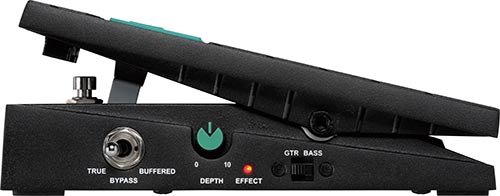 Image 2 of 4
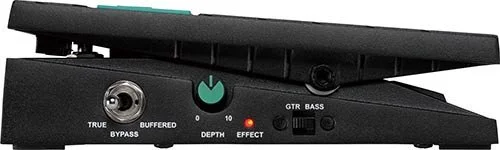 Image 3 of 4
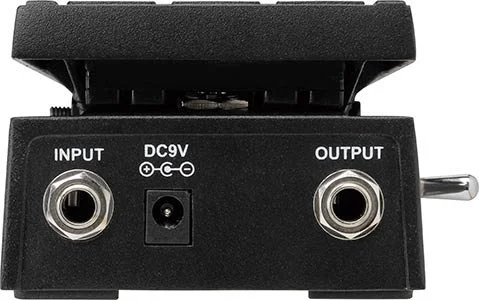 Image 4 of 4
Pedal Type: Dual-voiced guitar and bass wah-wah filter pedal
Frequency Range: Guitar Mode sweeps from 350 Hz to 2.2 kHz; Bass Mode drops one full octave to sweep from 175 Hz to 1.1 kHz
Boost/Cut Range: Integrated volume boost dynamically controlled via the adjustable side potentiometer (+6 dB to +20 dB peak)
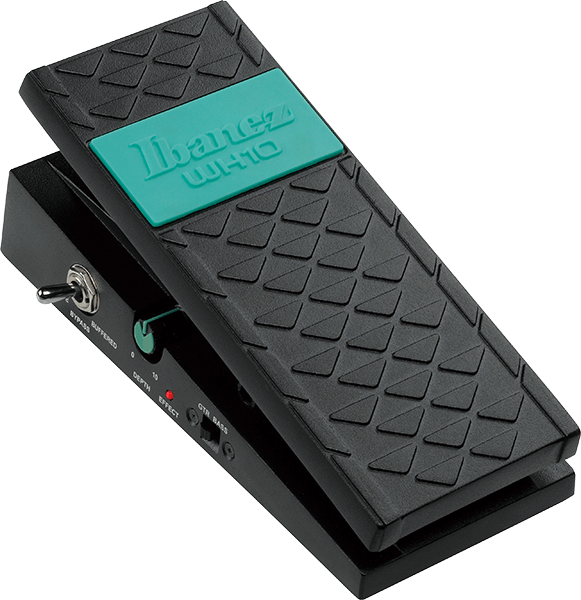
Controls: 1 rotary Depth knob, 1 side Guitar/Bass frequency slider, and 1 internal Buffered/True Bypass slider switch
Circuitry & Headroom: Pure analog signal path driven by a vintage-accurate multiple feedback operational amplifier matrix
Hardware & Bypass: Rugged die-cast aluminum alloy chassis finished in matte black with an adjustable under-treadle tension mechanical footswitch
I/O & Power Profile: 1/4-inch mono TS input (right side), 1/4-inch mono TS output (left side); runs on standard 9V DC or a single 9V battery drawing 125 mA max (12 mA nominal operational pull)
The core engineering of this unit departs from typical inductor-based wah-wah circuits by deploying a premium multiple feedback operational amplifier matrix. This classic configuration keeps operational gain perfectly uniform across the entire filter sweep, delivering exceptionally creamy filter response and woolly tonal interactions when driven by external dirt blocks. The side-mounted Depth knob dictates the overall intensity of the filter sweep, allowing engineers to transition smoothly from subtle, transparent filtering up to a massive, resonant sweep that pushes overdriven tube preamps into thick harmonic saturation.
The standout hardware advancement of this third-generation layout introduces a completely user-selectable bypass network on the interior circuit board. Players can leverage a toggle switch to run the unit in true bypass, which mechanical paths the dry signal completely away from the board to eliminate high-end attenuation when the effect is unengaged. Alternatively, switching to the buffered bypass circuit activates a low-impedance line driver designed to fight signal degradation across extensive pedalboard cable runs, preserving pristine top-end definition and ensuring quieter mechanical treadle engagement under high-gain performance conditions.
Equipped with an external, side-accessible sliding range selector, the pedal switches between optimized guitar and bass operational bandwidths. Guitar mode targets standard mid-range emphasis for soaring classic-rock leads or snappy funk accentuation, while Bass mode shifts the active band down by exactly one octave to process low-end fundamentals without compressing low transients or clipping sub-bass frequencies. When placed before heavy overdrive, distortion, or fuzz boxes, the integrated volume boost functions as a pre-gain filter booster, expanding the harmonic profile and thickening the note tracking of the downstream dirt circuit.
To ensure optimal performance and protect the sensitive internal analog operational amplifiers, this unit must be powered exclusively by a high-quality, regulated 9V DC external adapter with a center-negative barrel plug (5.5mm x 2.1mm) or a single standard 9V battery. The internal network functions with a nominal operational current draw of 12 mA at 9V DC. Exceeding the specified voltage threshold or utilizing unregulated AC-output power supplies will cause immediate thermal breakdown within the filtering network, voiding the factory warranty. Always disconnect the input jack when storing the pedal on battery power to prevent unnecessary drain on the internal battery circuit.
Pedal Type: Dual-voiced guitar and bass wah-wah filter pedal
Frequency Range: Guitar Mode sweeps from 350 Hz to 2.2 kHz; Bass Mode drops one full octave to sweep from 175 Hz to 1.1 kHz
Boost/Cut Range: Integrated volume boost dynamically controlled via the adjustable side potentiometer (+6 dB to +20 dB peak)
Controls: 1 rotary Depth knob, 1 side Guitar/Bass frequency slider, and 1 internal Buffered/True Bypass slider switch
Circuitry & Headroom: Pure analog signal path driven by a vintage-accurate multiple feedback operational amplifier matrix
Hardware & Bypass: Rugged die-cast aluminum alloy chassis finished in matte black with an adjustable under-treadle tension mechanical footswitch
I/O & Power Profile: 1/4-inch mono TS input (right side), 1/4-inch mono TS output (left side); runs on standard 9V DC or a single 9V battery drawing 125 mA max (12 mA nominal operational pull)
The core engineering of this unit departs from typical inductor-based wah-wah circuits by deploying a premium multiple feedback operational amplifier matrix. This classic configuration keeps operational gain perfectly uniform across the entire filter sweep, delivering exceptionally creamy filter response and woolly tonal interactions when driven by external dirt blocks. The side-mounted Depth knob dictates the overall intensity of the filter sweep, allowing engineers to transition smoothly from subtle, transparent filtering up to a massive, resonant sweep that pushes overdriven tube preamps into thick harmonic saturation.
The standout hardware advancement of this third-generation layout introduces a completely user-selectable bypass network on the interior circuit board. Players can leverage a toggle switch to run the unit in true bypass, which mechanical paths the dry signal completely away from the board to eliminate high-end attenuation when the effect is unengaged. Alternatively, switching to the buffered bypass circuit activates a low-impedance line driver designed to fight signal degradation across extensive pedalboard cable runs, preserving pristine top-end definition and ensuring quieter mechanical treadle engagement under high-gain performance conditions.
Equipped with an external, side-accessible sliding range selector, the pedal switches between optimized guitar and bass operational bandwidths. Guitar mode targets standard mid-range emphasis for soaring classic-rock leads or snappy funk accentuation, while Bass mode shifts the active band down by exactly one octave to process low-end fundamentals without compressing low transients or clipping sub-bass frequencies. When placed before heavy overdrive, distortion, or fuzz boxes, the integrated volume boost functions as a pre-gain filter booster, expanding the harmonic profile and thickening the note tracking of the downstream dirt circuit.
To ensure optimal performance and protect the sensitive internal analog operational amplifiers, this unit must be powered exclusively by a high-quality, regulated 9V DC external adapter with a center-negative barrel plug (5.5mm x 2.1mm) or a single standard 9V battery. The internal network functions with a nominal operational current draw of 12 mA at 9V DC. Exceeding the specified voltage threshold or utilizing unregulated AC-output power supplies will cause immediate thermal breakdown within the filtering network, voiding the factory warranty. Always disconnect the input jack when storing the pedal on battery power to prevent unnecessary drain on the internal battery circuit.