 Image 1 of 3
 Image 2 of 3
 Image 3 of 3
Pedal Type: Polyphonic Analog Amplitude Synthesizer and Compressor
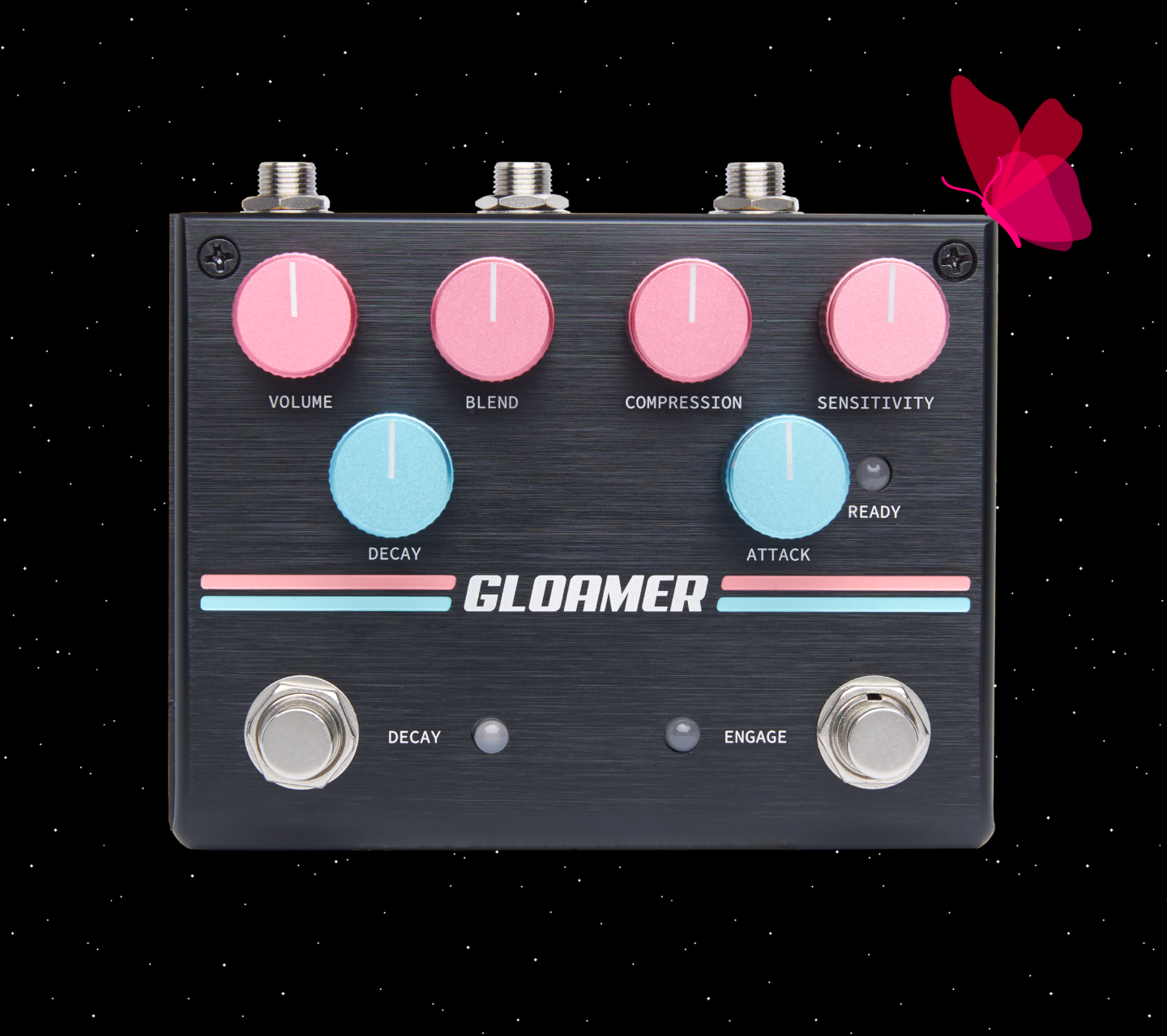
Controls: Volume, Compression, Blend, Attack, Decay, Sensitivity, Engage Footswitch, Decay Footswitch
Bypass Layout: True Bypass Switching
Power Requirements: 9VDC Negative Center Only (Do Not Exceed)
Current Draw: 100 mA
Dimensions: 4.75” × 3.5” × 2.5” (121 mm x 89 mm x 64 mm)
The Pigtronix Gloamer utilizes a fully analog, polyphonic tracking engine that reshapes the attack and decay envelopes of your instruments without fracturing chordal structures. The primary Attack circuit provides smooth, cinematic volume swells reminiscent of vintage bowed instruments, with variable timing parameters ranging from instantaneous acceleration to slow, evolving washes. The tracking responsiveness is governed by a dedicated Sensitivity circuit, which registers the dynamic audio input and arms the tracking engine. An integrated Ready LED provides immediate visual feedback, illuminating the precise millisecond the pedal has reset and stands ready to capture the next dynamic pick attack.
To maximize waveform tracking across elongated attack curves, the Gloamer integrates a high-headroom optical compressor layout. Adjusted via a independent Compression knob, this circuit injects dense sustain or punchy leveling to reinforce the decaying tail of a note before the envelope synthesizer manipulates it. The master Volume control establishes the unified output level at the apex of the envelope rise, preventing volume jumps when the pedal is activated. For musicians wanting to preserve raw instrument string articulation, an integrated parallel Blend circuit allows you to layer the uncompressed, un-attenuated dry audio signal directly beneath the synthetic volume swell.
To synthesize an authentic cello or violin-style performance footprint with absolute note isolation, engage the pedal with the Decay footswitch inactive. Position the Attack control at 12 o'clock, Compression at 2 o'clock, and turn the Blend knob fully clockwise to isolate the wet processing line. Set the Sensitivity knob to 3 o'clock to accommodate natural playing thresholds. As you stroke a chord, the envelope will smoothly swell from total silence to full saturation. To chain subsequent notes into a continuous legato passage, you must mute the strings completely between strikes to drop the input level below the detection floor, prompting the internal circuit to auto-reset and arm the next swell cycle.
For pulsing, polyphonic modulation that moves beyond standard LFO shapes, activate both the Engage and Decay footswitches. Set both the Attack and Decay dials to 9 o'clock, configure the Compression control to noon, and keep the Blend fully wet. With this optimization, when a single note or complex chord is held, the auto-reset circuit traps the audio in an endless loop: the attack cycle swells to peak level, immediately drops off based on the Decay setting, and re-triggers the attack phase instantly without requiring manual pick strikes. This creates an organic, undulating, asymmetrical tremolo effect that pulses in direct response to the continuous instrument input.
POWER REQUIREMENTS: THIS DEVICE OPERATES SOLELY ON A 9VDC EXTERNAL POWER SUPPLY UTILIZING A STANDARD 2.1MM REVERSE-POLARITY CENTER-NEGATIVE PLUG. DO NOT ATTEMPT TO OPERATE THIS DEVICE REQUIRING BATTERY POWER AS THERE IS NO INTERNAL BATTERY COMPARTMENT. EXCEEDING THE RATED 9VDC INPUT CAP OR UTILIZING AN ALTERNATING CURRENT (AC) SOURCE CAN INDUCE SEVERE SYSTEM FAILURE, RENDER THE OPTICAL COMPRESSION STAGE INOPERABLE, AND ENTIRELY VOID ALL STANDING MANUFACTURER WARRANTIES.
Pedal Type: Polyphonic Analog Amplitude Synthesizer and Compressor
Controls: Volume, Compression, Blend, Attack, Decay, Sensitivity, Engage Footswitch, Decay Footswitch
Bypass Layout: True Bypass Switching
Power Requirements: 9VDC Negative Center Only (Do Not Exceed)
Current Draw: 100 mA
Dimensions: 4.75” × 3.5” × 2.5” (121 mm x 89 mm x 64 mm)
The Pigtronix Gloamer utilizes a fully analog, polyphonic tracking engine that reshapes the attack and decay envelopes of your instruments without fracturing chordal structures. The primary Attack circuit provides smooth, cinematic volume swells reminiscent of vintage bowed instruments, with variable timing parameters ranging from instantaneous acceleration to slow, evolving washes. The tracking responsiveness is governed by a dedicated Sensitivity circuit, which registers the dynamic audio input and arms the tracking engine. An integrated Ready LED provides immediate visual feedback, illuminating the precise millisecond the pedal has reset and stands ready to capture the next dynamic pick attack.
To maximize waveform tracking across elongated attack curves, the Gloamer integrates a high-headroom optical compressor layout. Adjusted via a independent Compression knob, this circuit injects dense sustain or punchy leveling to reinforce the decaying tail of a note before the envelope synthesizer manipulates it. The master Volume control establishes the unified output level at the apex of the envelope rise, preventing volume jumps when the pedal is activated. For musicians wanting to preserve raw instrument string articulation, an integrated parallel Blend circuit allows you to layer the uncompressed, un-attenuated dry audio signal directly beneath the synthetic volume swell.
To synthesize an authentic cello or violin-style performance footprint with absolute note isolation, engage the pedal with the Decay footswitch inactive. Position the Attack control at 12 o'clock, Compression at 2 o'clock, and turn the Blend knob fully clockwise to isolate the wet processing line. Set the Sensitivity knob to 3 o'clock to accommodate natural playing thresholds. As you stroke a chord, the envelope will smoothly swell from total silence to full saturation. To chain subsequent notes into a continuous legato passage, you must mute the strings completely between strikes to drop the input level below the detection floor, prompting the internal circuit to auto-reset and arm the next swell cycle.
For pulsing, polyphonic modulation that moves beyond standard LFO shapes, activate both the Engage and Decay footswitches. Set both the Attack and Decay dials to 9 o'clock, configure the Compression control to noon, and keep the Blend fully wet. With this optimization, when a single note or complex chord is held, the auto-reset circuit traps the audio in an endless loop: the attack cycle swells to peak level, immediately drops off based on the Decay setting, and re-triggers the attack phase instantly without requiring manual pick strikes. This creates an organic, undulating, asymmetrical tremolo effect that pulses in direct response to the continuous instrument input.
POWER REQUIREMENTS: THIS DEVICE OPERATES SOLELY ON A 9VDC EXTERNAL POWER SUPPLY UTILIZING A STANDARD 2.1MM REVERSE-POLARITY CENTER-NEGATIVE PLUG. DO NOT ATTEMPT TO OPERATE THIS DEVICE REQUIRING BATTERY POWER AS THERE IS NO INTERNAL BATTERY COMPARTMENT. EXCEEDING THE RATED 9VDC INPUT CAP OR UTILIZING AN ALTERNATING CURRENT (AC) SOURCE CAN INDUCE SEVERE SYSTEM FAILURE, RENDER THE OPTICAL COMPRESSION STAGE INOPERABLE, AND ENTIRELY VOID ALL STANDING MANUFACTURER WARRANTIES.