 Image 1 of 3
 Image 2 of 3
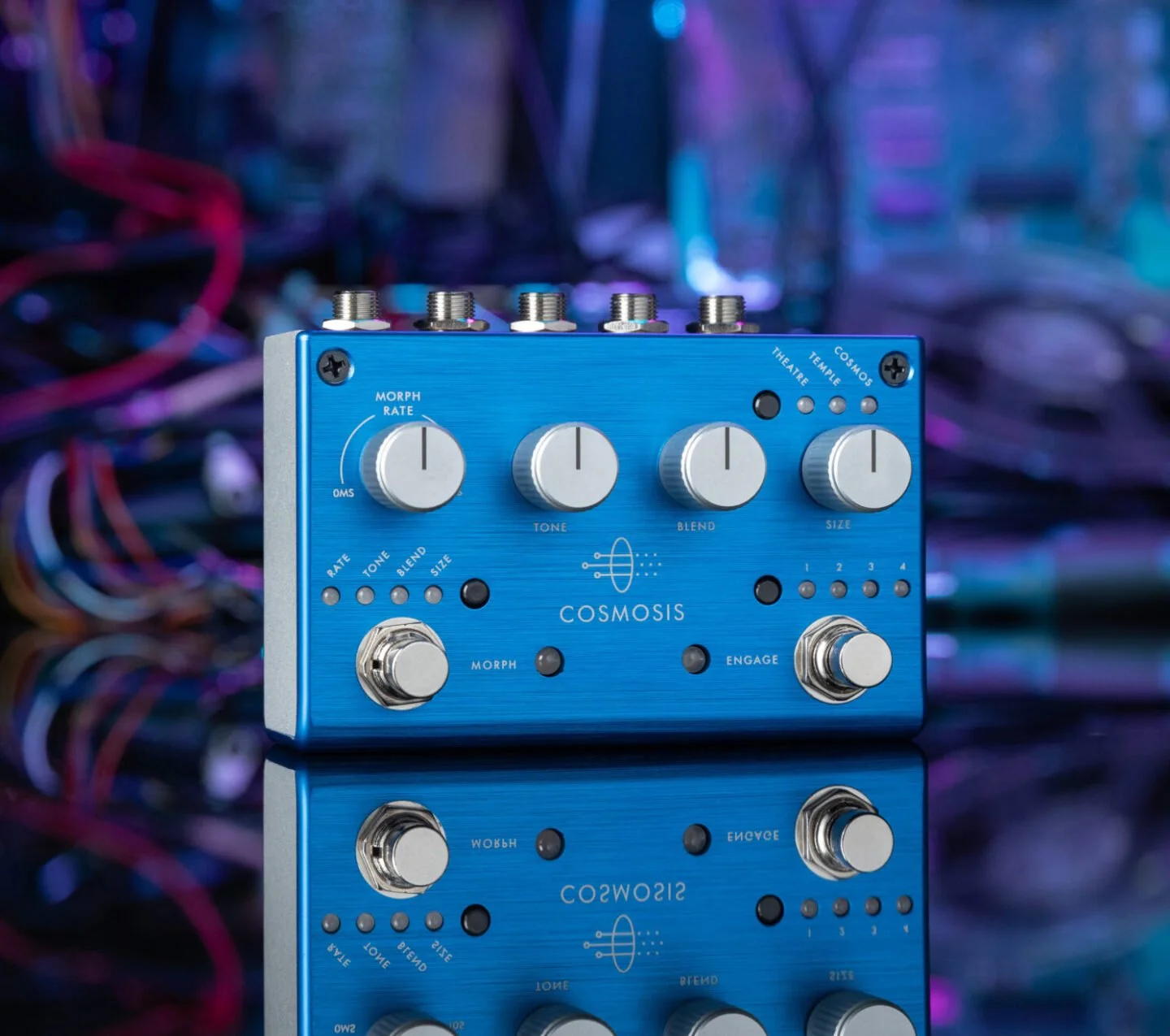 Image 3 of 3
Pedal Type: Stereo Ambient Morphing Reverb
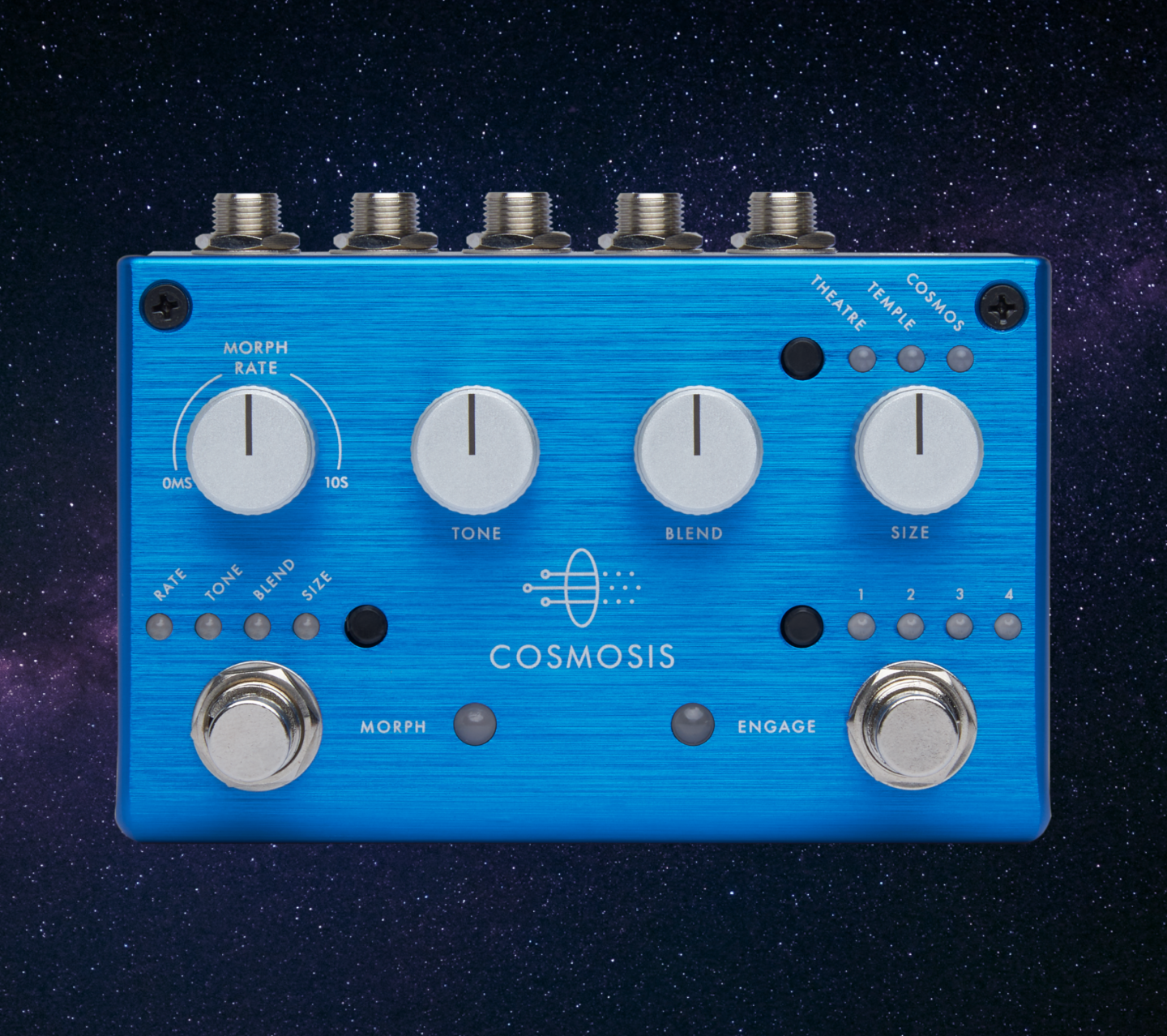
Controls: Blend, Size, Tone, Morph Rate, Morph Button, Preset Select Button, Space Select Button, Engage Footswitch, Morph Footswitch
Bypass Layout: Buffered Bypass
Power Requirements: 9VDC Negative Center Only (Do Not Exceed)
Current Draw: 100 mA
Dimensions: 4.53” × 3.35” × 2.16” (115 mm x 85 mm x 55 mm)
The Pigtronix Cosmosis utilizes a high-headroom digital signal processing core to run three original ambient reverb spaces engineered from primary source impulse responses and complex mathematical reflections. The internal memory operates on a dual-layer assignment structure denoted by green and red states. This layout lets you establish independent physical positions for the Tone, Blend, and Size controls across both layers simultaneously. Rather than snap-switching between two static patches, the internal processing engine acts as a digital macro-controller to continuously interpolate the numerical difference between the assigned coordinates.
A trio of onboard LED touch-switches provides instant navigation across three distinct, tailor-made environmental algorithms. Theatre mode chains short, parallel reverberators together to mimic small-to-mid room reflections while maintaining natural early reflection dynamics. Temple shifts into a wide, dramatic indoor space using a network of elongated reflections aligned in both parallel and series combinations. Cosmos generates an evolving, reactive spectrum of ambient diffusion that derives its decay characteristics directly from the harmonic profile of the audio input. Signal equalization is governed by a dual-functioning, center-detent Tone engine that applies a low-pass filter when moved counterclockwise from noon and a high-pass filter when turned clockwise.
To configure a wide, cinematic landscape that gradually expands from a subtle room reflection into an infinite wash, set the Space selector to Cosmos. Wire your instrument into both input jacks to utilize the true stereo pathing, and assign the Morph Footswitch to adjust the Size and Blend knobs simultaneously. Set your green layer baseline with the Size at 10 o'clock and the Blend at 9 o'clock, then adjust the red layer targets to 4 o'clock on both controls. Set the Morph Rate knob to 3 o'clock to introduce an extended, multi-second transit line. When you strike a chord and depress the Morph Footswitch, the acoustic boundary of the reverb smoothly expands in real time to simulate expanding physical space.
For fast, rhythmic modulation that acts as a pseudo-tremolo effect across your ambient trails, engage the Temple space profile. Set the green layer with the Tone knob rolled back to 9 o'clock for a dark, warm foundation, and assign the red layer with the Tone knob advanced to 3 o'clock to emphasize bright reflections. Position the Morph Rate control to 9 o'clock to initiate high-speed parameter travel. Rapidly tapping or holding the Morph Footswitch forces the equalization filter to bounce continuously between the two targeted frequency profiles, instigating a bright, sweeping shimmer that pulses in direct synchronization with your performance pacing.
POWER REQUIREMENTS: RUNS EXCLUSIVELY ON AN EXTERNAL 9VDC REGULATED POWER SUPPLY REGULATING A COMPATIBLE 2.1MM BARREL PLUG WITH REVERSE POLARITY (CENTER NEGATIVE). THIS PIECE OF HARDWARE CANNOT BE RUN VIA INTERNAL BATTERY POWER. NEVER CONNECT AC VOLTAGE OR DC CURRENT EXCEEDING THE MANDATED 9V THRESHOLD. OVER-VOLTAGE OR INCORRECT LINE TERMINATION REGULARLY BLOWS THE HIGH-FIDELITY DIGITAL DSP NETWORKS, WILL DESTROY THE INTERNAL SWITCH ENGINES, AND VOIDS ALL APPLICABLE MANUFACTURER WARRANTIES.
Pedal Type: Stereo Ambient Morphing Reverb
Controls: Blend, Size, Tone, Morph Rate, Morph Button, Preset Select Button, Space Select Button, Engage Footswitch, Morph Footswitch
Bypass Layout: Buffered Bypass
Power Requirements: 9VDC Negative Center Only (Do Not Exceed)
Current Draw: 100 mA
Dimensions: 4.53” × 3.35” × 2.16” (115 mm x 85 mm x 55 mm)
The Pigtronix Cosmosis utilizes a high-headroom digital signal processing core to run three original ambient reverb spaces engineered from primary source impulse responses and complex mathematical reflections. The internal memory operates on a dual-layer assignment structure denoted by green and red states. This layout lets you establish independent physical positions for the Tone, Blend, and Size controls across both layers simultaneously. Rather than snap-switching between two static patches, the internal processing engine acts as a digital macro-controller to continuously interpolate the numerical difference between the assigned coordinates.
A trio of onboard LED touch-switches provides instant navigation across three distinct, tailor-made environmental algorithms. Theatre mode chains short, parallel reverberators together to mimic small-to-mid room reflections while maintaining natural early reflection dynamics. Temple shifts into a wide, dramatic indoor space using a network of elongated reflections aligned in both parallel and series combinations. Cosmos generates an evolving, reactive spectrum of ambient diffusion that derives its decay characteristics directly from the harmonic profile of the audio input. Signal equalization is governed by a dual-functioning, center-detent Tone engine that applies a low-pass filter when moved counterclockwise from noon and a high-pass filter when turned clockwise.
To configure a wide, cinematic landscape that gradually expands from a subtle room reflection into an infinite wash, set the Space selector to Cosmos. Wire your instrument into both input jacks to utilize the true stereo pathing, and assign the Morph Footswitch to adjust the Size and Blend knobs simultaneously. Set your green layer baseline with the Size at 10 o'clock and the Blend at 9 o'clock, then adjust the red layer targets to 4 o'clock on both controls. Set the Morph Rate knob to 3 o'clock to introduce an extended, multi-second transit line. When you strike a chord and depress the Morph Footswitch, the acoustic boundary of the reverb smoothly expands in real time to simulate expanding physical space.
For fast, rhythmic modulation that acts as a pseudo-tremolo effect across your ambient trails, engage the Temple space profile. Set the green layer with the Tone knob rolled back to 9 o'clock for a dark, warm foundation, and assign the red layer with the Tone knob advanced to 3 o'clock to emphasize bright reflections. Position the Morph Rate control to 9 o'clock to initiate high-speed parameter travel. Rapidly tapping or holding the Morph Footswitch forces the equalization filter to bounce continuously between the two targeted frequency profiles, instigating a bright, sweeping shimmer that pulses in direct synchronization with your performance pacing.
POWER REQUIREMENTS: RUNS EXCLUSIVELY ON AN EXTERNAL 9VDC REGULATED POWER SUPPLY REGULATING A COMPATIBLE 2.1MM BARREL PLUG WITH REVERSE POLARITY (CENTER NEGATIVE). THIS PIECE OF HARDWARE CANNOT BE RUN VIA INTERNAL BATTERY POWER. NEVER CONNECT AC VOLTAGE OR DC CURRENT EXCEEDING THE MANDATED 9V THRESHOLD. OVER-VOLTAGE OR INCORRECT LINE TERMINATION REGULARLY BLOWS THE HIGH-FIDELITY DIGITAL DSP NETWORKS, WILL DESTROY THE INTERNAL SWITCH ENGINES, AND VOIDS ALL APPLICABLE MANUFACTURER WARRANTIES.